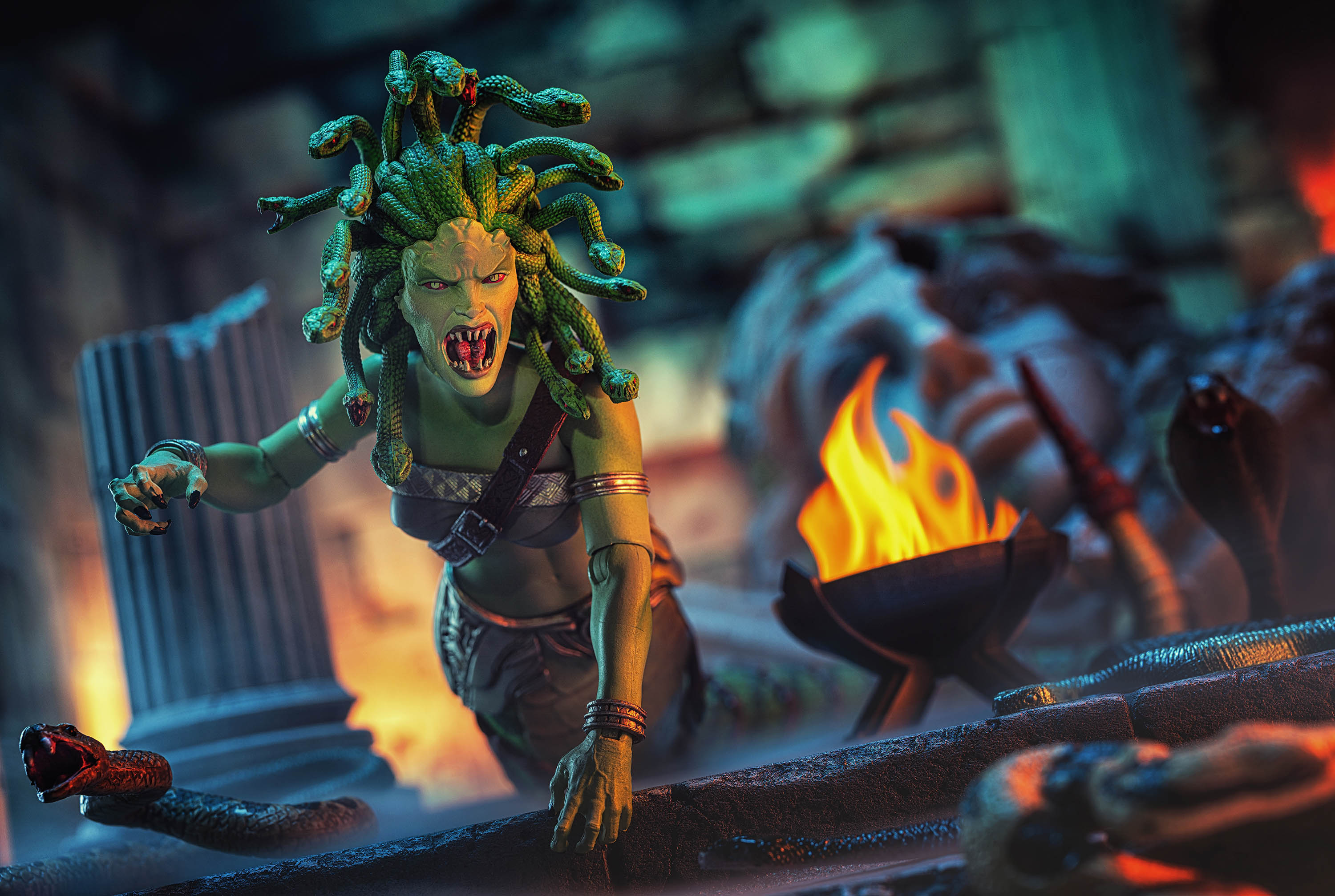
Medusa's Story
Author’s note: like most myths from the ancient world, there are numerous variations to be found in the story of Medusa. This page, and the booklet included with the figure, takes these various versions into account and presents yet another telling by combining elements of different versions.
The ancient sea gods, Phorcys and Ceto, had many offspring. Amongst these children of the sea gods was the “mother of all monsters” – the snake-woman named Echinda, the dragon Ladon who guarded the golden apples and was killed by Hercules, and the Graeae – a trio of grey-haired sisters who shared one eye and one tooth and who guarded the pathway to the lair of Phorcys and Ceto’s final children – the Gorgons.
There were three Gorgons - Ssteno the Strong, Euryale the Far Roaming, and the youngest of the three – Medusa.
Medusa was the only one of the Gorgons who was mortal, and unlike her monstrous siblings, she was beautiful with long, wonderous hair. Medusa served as a priestess in the Temple of Athena.
Medusa’s beauty attracted the attention of the sea-god, Poseidon, and eventually the two of them eventually lay together under the roof of Athena’s temple.
Poseidon and his niece, Athena, had a long-standing feud between them. They had both vied to be the patron of the city of Athens, and Athena had been awarded that honor by Zeus, who was the father to Athena and brother to Poseidon. Athena saw the desecration of her temple as an insult to her, but rather than punish her uncle, she took her rage out on her priestess, Medusa.
Athena cursed Medusa, turning her beautiful hair into a writhing mass of snakes. Her beautiful features were twisted and warped so that she became so hideous, that all who looked upon her were immediately turned to stone.
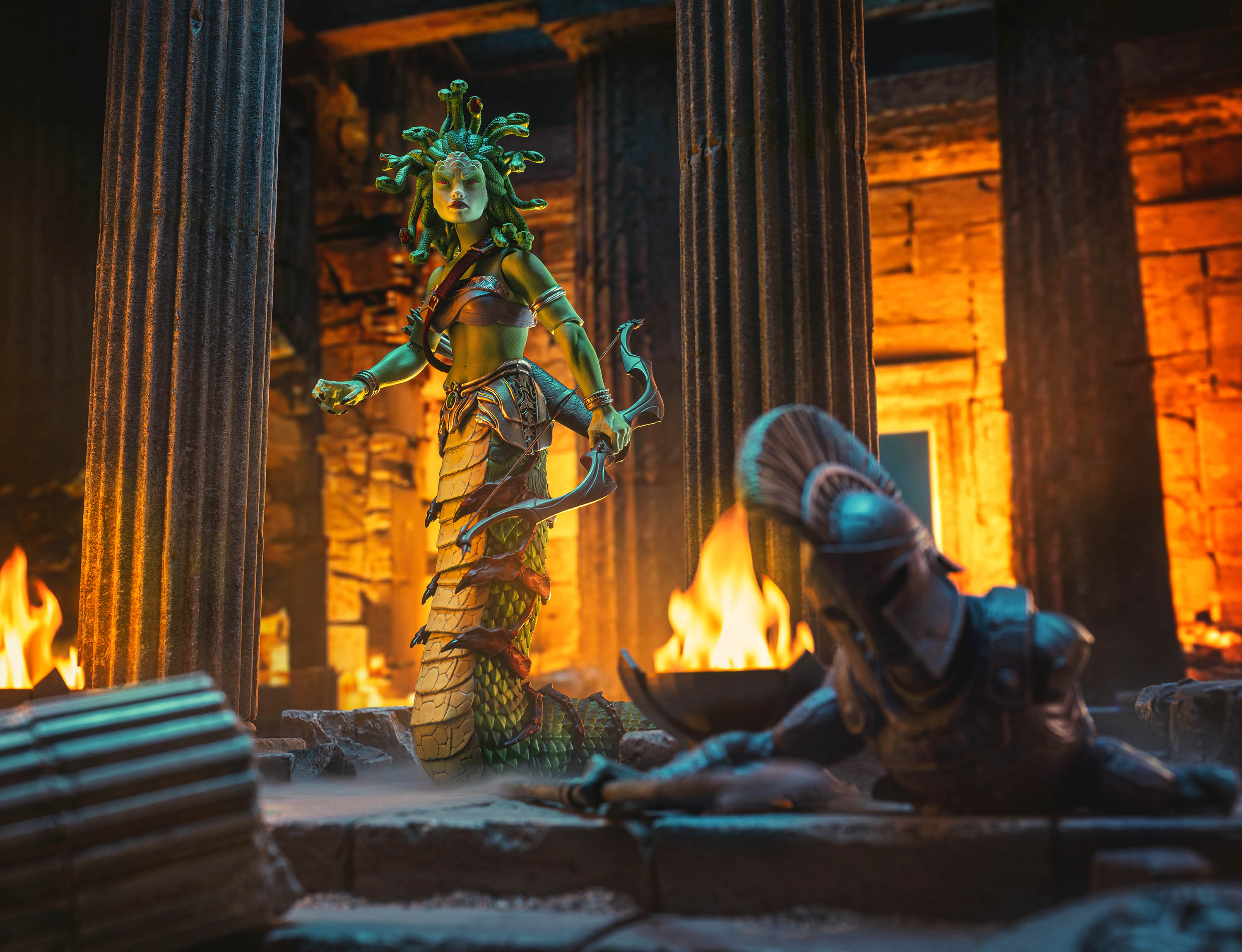
Fleeing the temple, Medusa joined her sisters on the island of Sarpendon, in the far west near Oceanus. Many warriors would come to visit this island seeking to kill the monstrous offspring of Phorcys and Ceto, but none would survive their quest until the hero known as Perseus.
King Acrisius of Argos had married the Spartan princess, Eurydice. Together they had a daughter named Danaë. Wanting a son, the King consulted the Oracle at Delphi and was warned that he would one day he killed by his daughter’s son.
Fearing this prophecy, King Acrisus imprisoned Danaë to keep her childless, but Zeus intervened and Danaë found herself with child. Infuriated by this turn of events, the King placed his daughter and her baby son, whom she had named Perseus, inside a box and had it thrown into the sea.
Adrift on the waves, Zeus implored Poseidon to calm the waters, and the sea-god guided the box to the island of Seriphos. It was here that a fisherman found the box and the pair inside and protected them. Thus Danaë and Perseus survived, far from the clutches of King Acrisus.
The fisherman who had protected Danaë and Perseus was, in fact, the brother of Seriphos’ king, Polydectes. That king fell in love with Danaë, and wished to be rid of Perseus, who had now grown into a young man. Wishing to see Perseus gone, he sent him on an impossible quest – to slay the Gorgon, Medusa, and to return with her head as a trophy.
Perseus knew that this task was beyond him, for it was said that any who looked upon the Gorgon would be turned to stone. Still, Perseus set off his quest, refusing to allow his fear to stop him from attempting to meet the challenge of the King of Seriphos.
Perseus looked for the Gorgons for months without luck, but the intervention of Hermes and Athena led him to the lair of the Graeae. These were three old witches who shared a single eye and a single tooth amongst them. Perseus stole the eye and the tooth from the Graeae and demanded to know the location of Medusa’s lair in exchange for their return. Receiving the information he sought, Perseus returned the eye and tooth and set out to meet the Gorgons.
The hero would not go unarmed in his quest, for Hermes and Athena provided for him once again. Hermes gave Perseus a pair of winged sandals with which he could fly, a cloak of invisibility, a bag that would grow to any size, and a sword capable of cutting through anything. Athena added to these gifts a shiny, bronze shield.
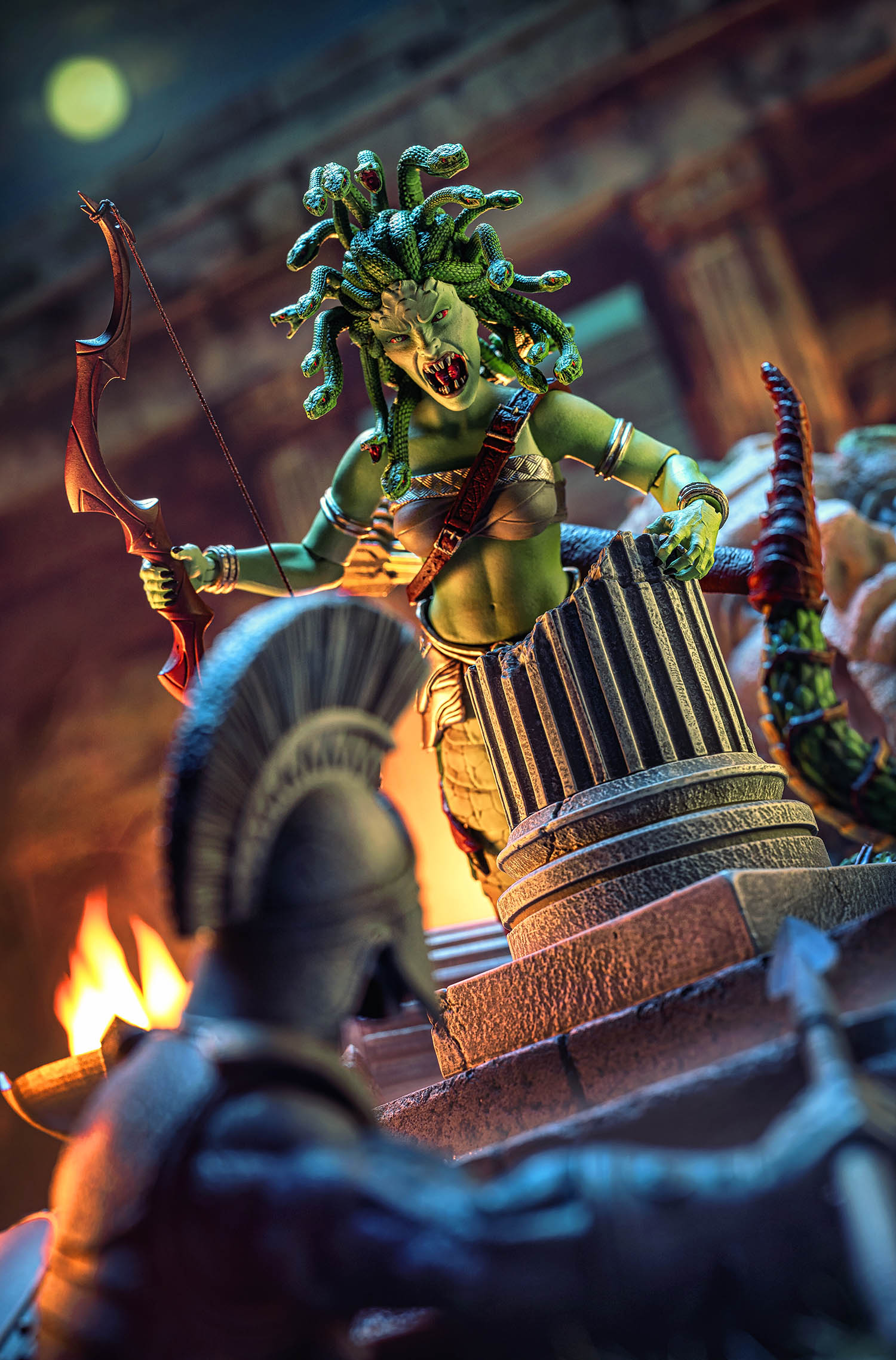
Perseus made his way to Sarpendon where the Gorgons lived. Making his way onto the island and towards the Gorgons’ lair, he saw the landscape littered with the stone remnants of warriors who had come before him. Each of them had sought to destroy the Gorgons in an act of heroism, and each had gazed upon them and been frozen in stone forever.
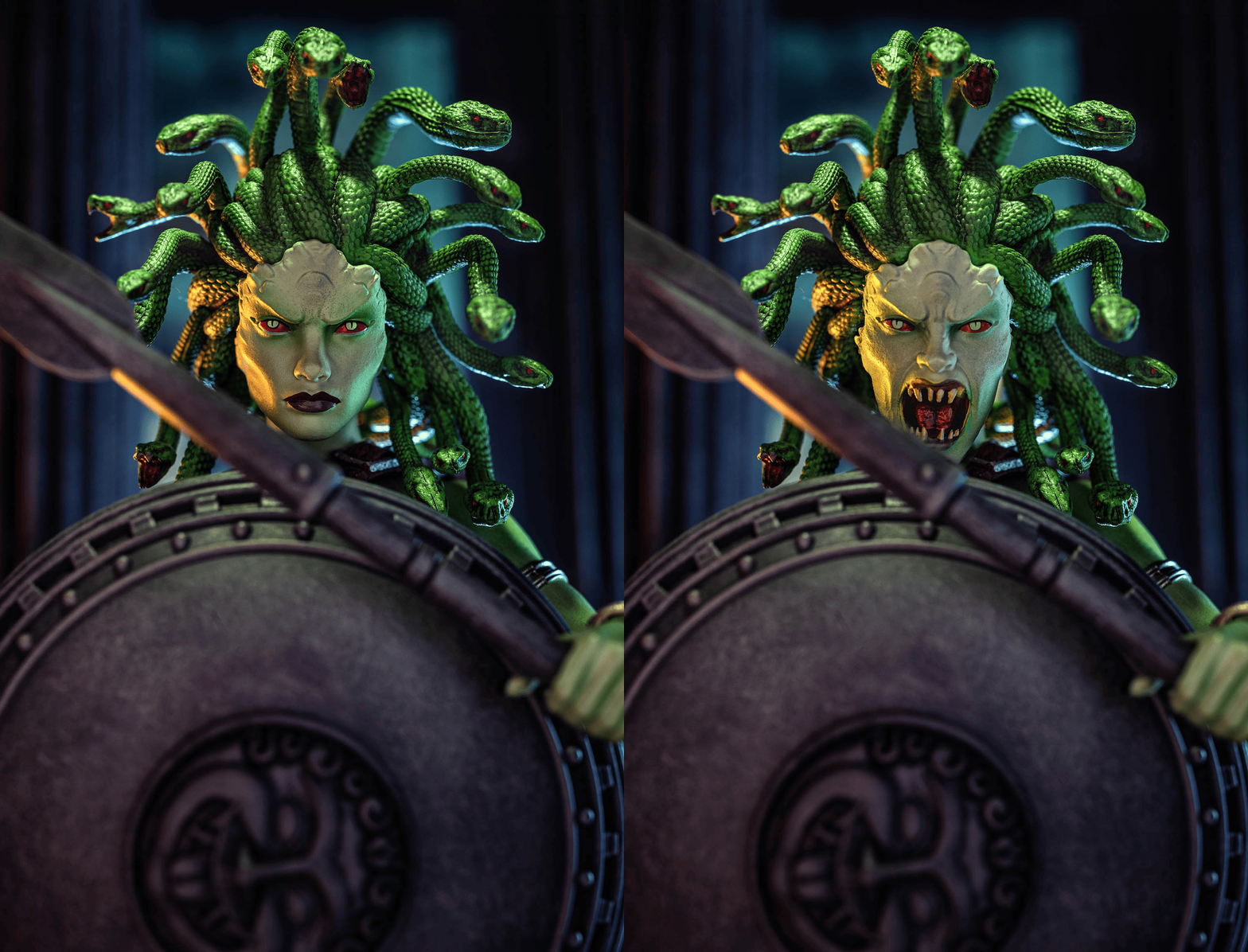
Undeterred, Perseus made his way into the Gorgons’ lair. He found the three Gorgon sisters, including Medusa, asleep. Knowing he could not look upon her lest he be turned to stone, Perseus used the shield that Athena had given hm to see her reflection without actually looking upon her directly. When Medusa realized there was an intruder in her home and tried to attack, Perseus took action and severed her head with his sword. Still averting his eyes, he placed Medusa’s head inside of Hermes’ bag and made his way out of the Gorgon’s lair just as her sisters awoke and found the decapitated body of their youngest sibling before them.
The remaining Gorgons pursued Perseus seeking revenge, but the hero escaped their clutches. Some say he flew away with the aid of the sandals that Hermes had gifted him, while other versions of the tale suggest that he rode the winged horse, Pegasus, away; that magical beast having sprung to life from the spilled blood of Medusa. However he made his escape, Perseus took the head of Medusa with him and used it during the challenges that he would soon face.
First Perseus would save the prince of Ethiopia, Andromeda, from a sea monster. Andromeda was being sacrificed to the monster in order to protect the country. Perseus promised the king that he could kill the monster, and asked for Andromeda’s hand in marriage if he succeeded. The king agreed, and Perseus used his magical weapons, including the head of Medusa, to slay the sea monster. He and Andromeda wed soon after.
Finally making his way back to Seriphus, Perseus discovered that Polydectes had grown more ruthless and cruel in his absence. Perseus entered the palace of the king and showed him the prize he had been sent to retrieve. Even in death, the gaze of Medusa was deadly, and the evil king and his followers were all turned to stone.
Perseus eventually gave the severed head of Medusa to Athena, who placed it upon her shield which she called the Aegis. This was a somewhat circular turn of events, for it was Athena who had cursed Medusa and now bore her visage on her shield.
The circular nature of stories can also be found in Perseus’s tale, for many years later the hero would encounter his grandfather, King Acrisius, and fulfill the prophecy of his demise.
King Acrisius was visiting a nearby kingdom to witness a series of athletic contests. Unbeknownst to him, his grandson whom he thought long dead, Perseus, was competing in the contest. Perseus threw a discus that hit King Acrisius, killing him instantly, completing the prophecy spoken by the Oracle many years prior.
Perseus, his wife Andromeda, and his mother Danaë lived the remainder of their lives in happiness.
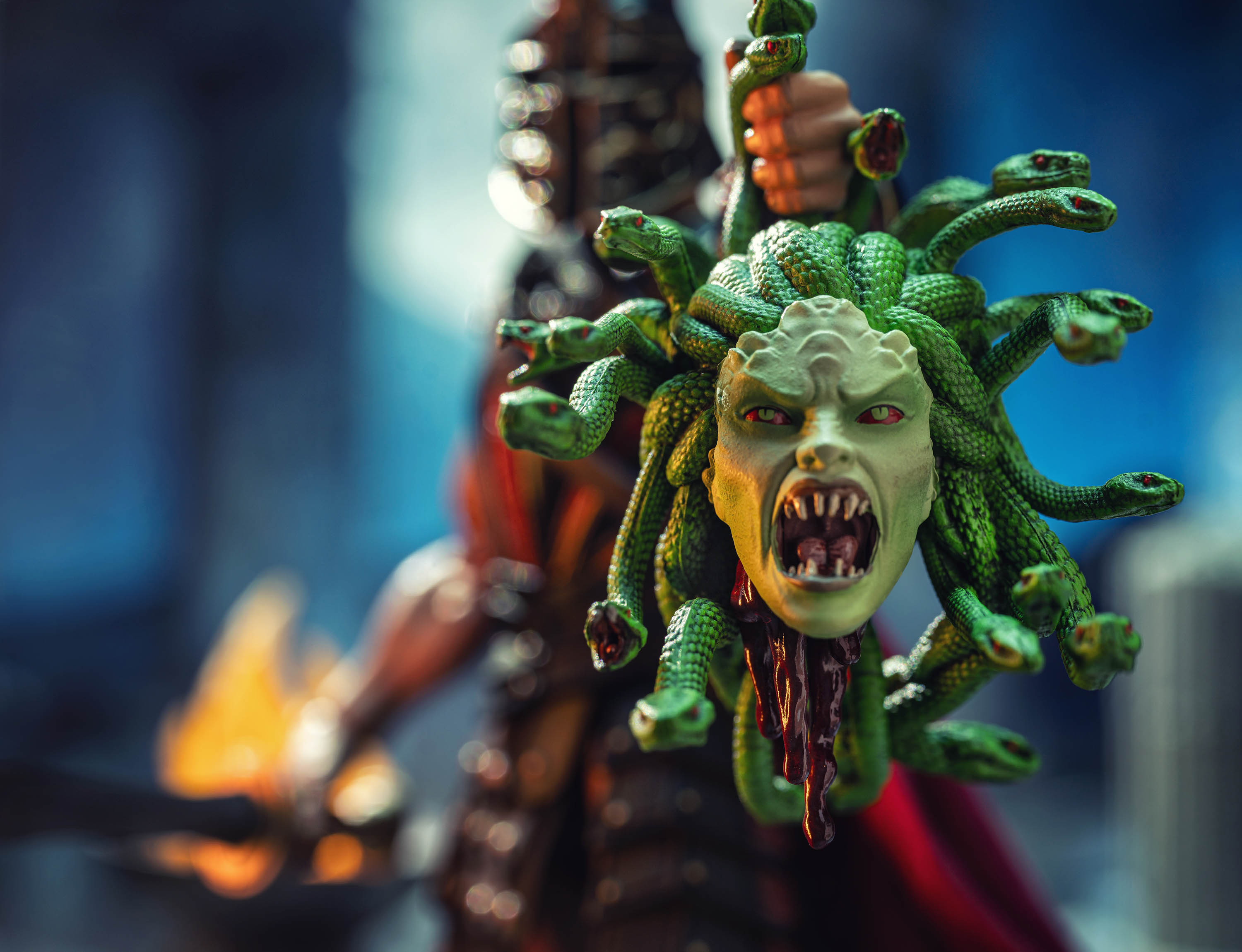
Medusa the Protectress
The story of Medusa is indeed a tragic one, but is also a tale that has transformed over the years as this one-time monster is seen today as a symbol of female strength and empowerment.
The name “Medusa” means “guardian” or “protectress” and even in ancient times her visage was placed upon soldiers’ shields and armor, as well as on buildings, to ward off evil and provide protection in battle.
In modern times, Medusa’s story has been reconsidered and she has been recast as a victim rather than a monster. Her sad tale has been reframed to symbolize female strength and resilience, for even in death Medusa was powerful – not even the Gods could take that power from her. Medusa’s image and her story have stood the test of time and she remains one of the most iconic and important characters in the history of ancient mythology.
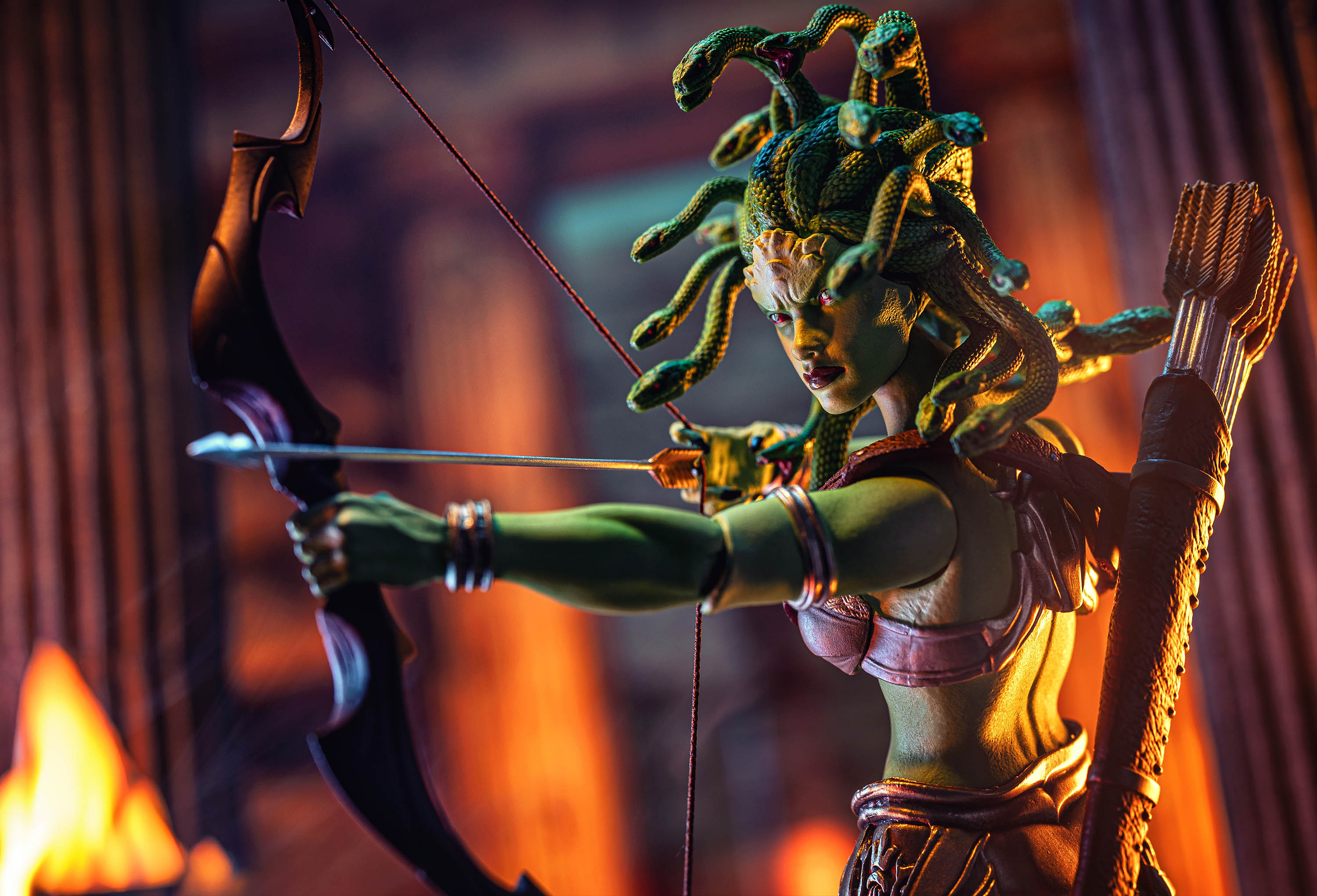
Medusa on the Screen
For many, the images that come to mind when they think of Medusa are scenes from the classic movie, The Clash of the Titans. Released in the early 1980s and starring Harry Hamelin as Perseus, this movie featured the stop-motion wizardry of the great Ray Harryhausen. In fact, Clash of the Titan’s was the last film this stop-motion master worked on before he retired.
Clash of the Titans presents Medusa purely as a monster, and as related in the tale above, she does meet her end thanks to Perseus’ quest.
While the 1981 version of Clash of the Titans is arguably Medusa’s most prominent brush with Hollywood, the character had appeared in movies before that time (Medusa Against the Son of Hercules in 1963 and The Gorgon in 1964) and after (Percy Jackson & the Olympians: The Lightning Thief in 2010 and a remake of Clash of the Titans from that same year). Gorgons have also appeared in numerous television shows over the years, sometimes as antagonists and other times as main characters, including Monster High, Chilling Adventures of Sabrina, Supernatural, Wednesday, Dr. Who, Scooby Doo, and many more.
Medusa in Figura Obscura
Medusa has been on our list of possible inclusions in Figura Obscura since the earliest days of the line - and the reveal of the serpentine Bassylia figure from the Mythic Legions: Reign of the Beasts wave all but assured that it would not be long before Medusa would cast her gaze upon Figura Obsura fans.
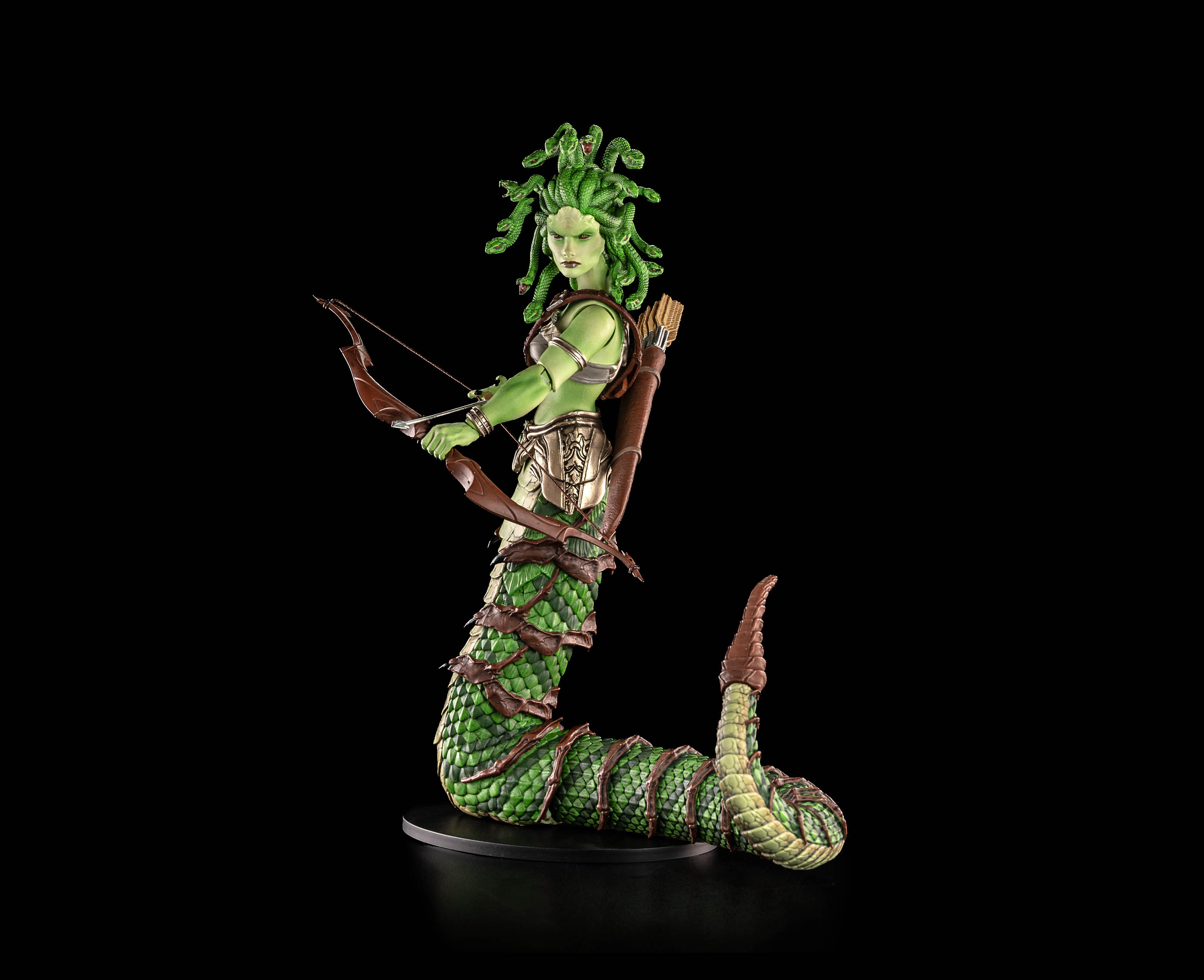
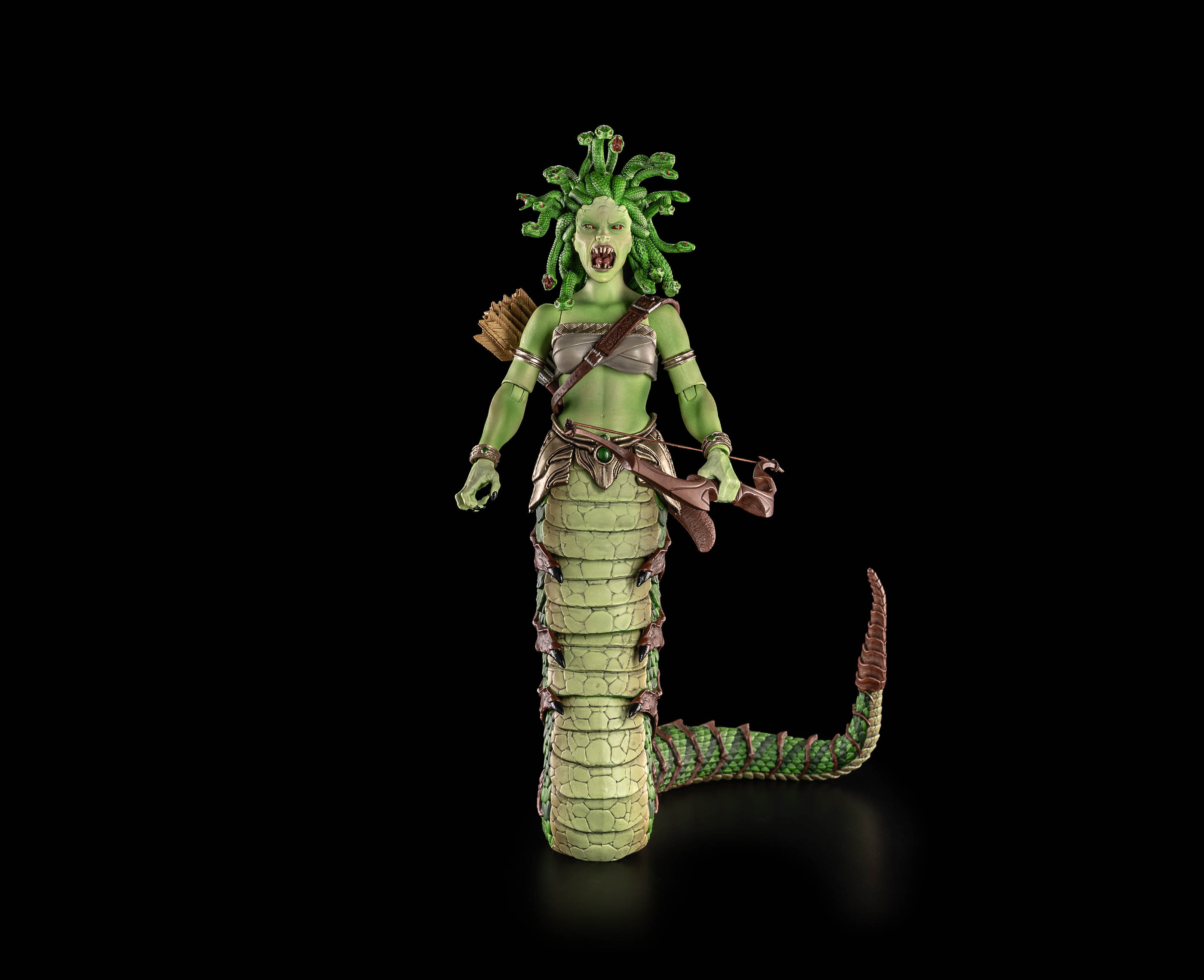
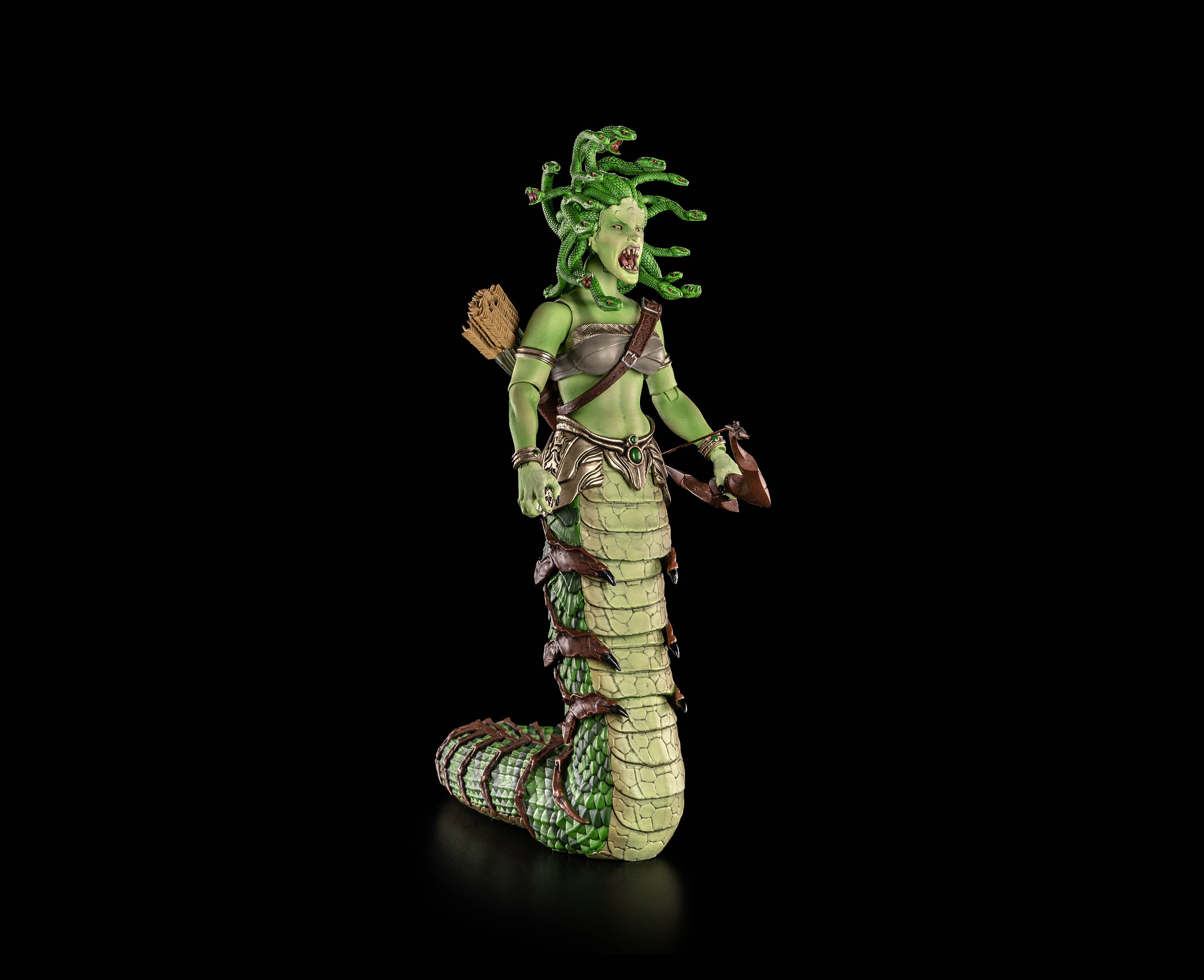
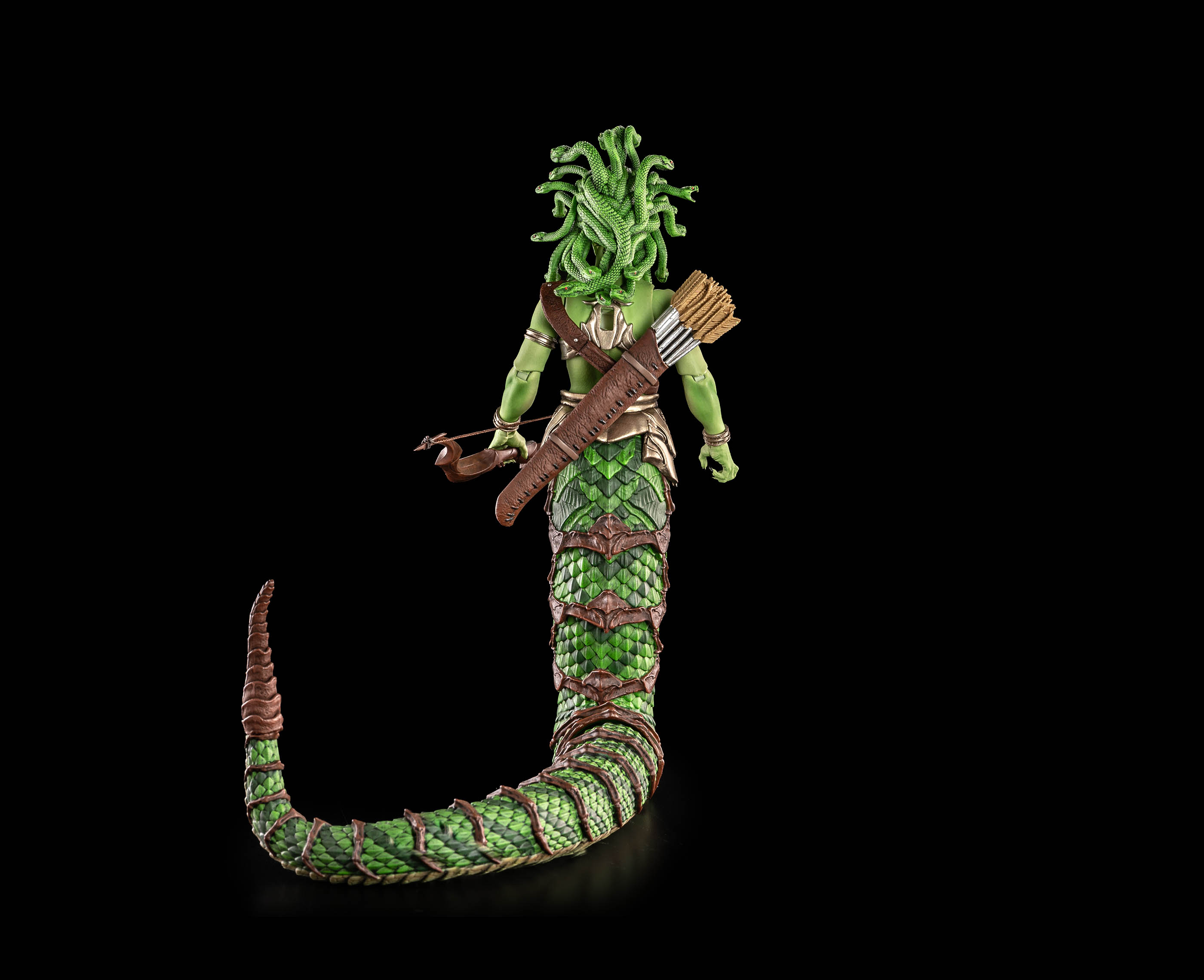
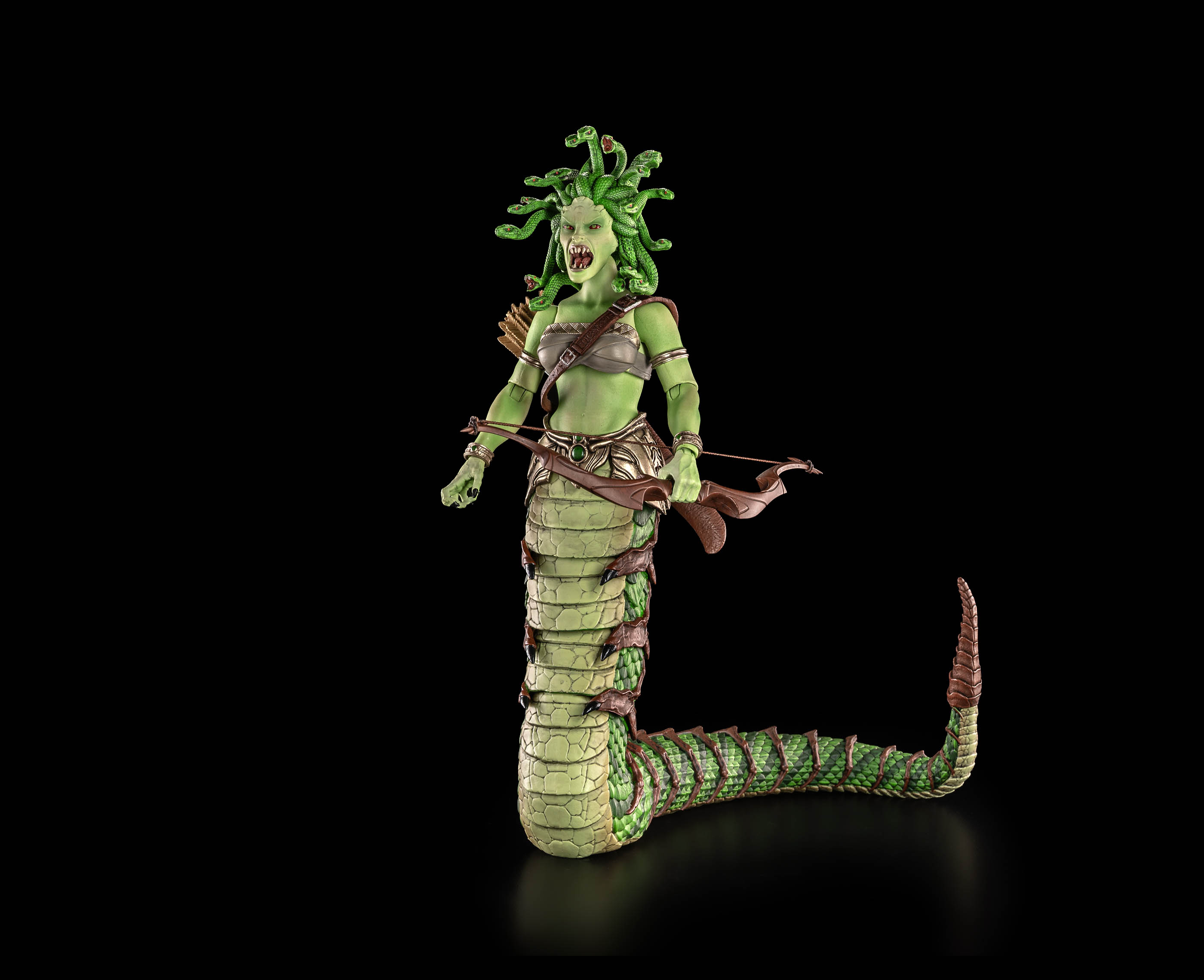
One interesting aspect on Medusa is that she is a character that is so well-known and iconic, and yet there has never really been a definitive way she has been presented. While many people know of the monstrous look of Medusa from the aforementioned movie “The Clash of the Titans”, there are also many depictions of her where she is beautiful rather than horrifying - although the head of snakes and serpentine tail are almost always present, even when Medusa’s beauty is played up. Sometimes Medusa is all green, while other times her upper body is more of a lighter flesh tone similar to a how a mermaid is often portrayed. This absence of a truly definitiative look for Medusa allowed Eric Treadaway to decide how he wanted this new Figura Obscura figure to look and to create what is absolutely a Four Horsemen Studios’ rendition of the character.
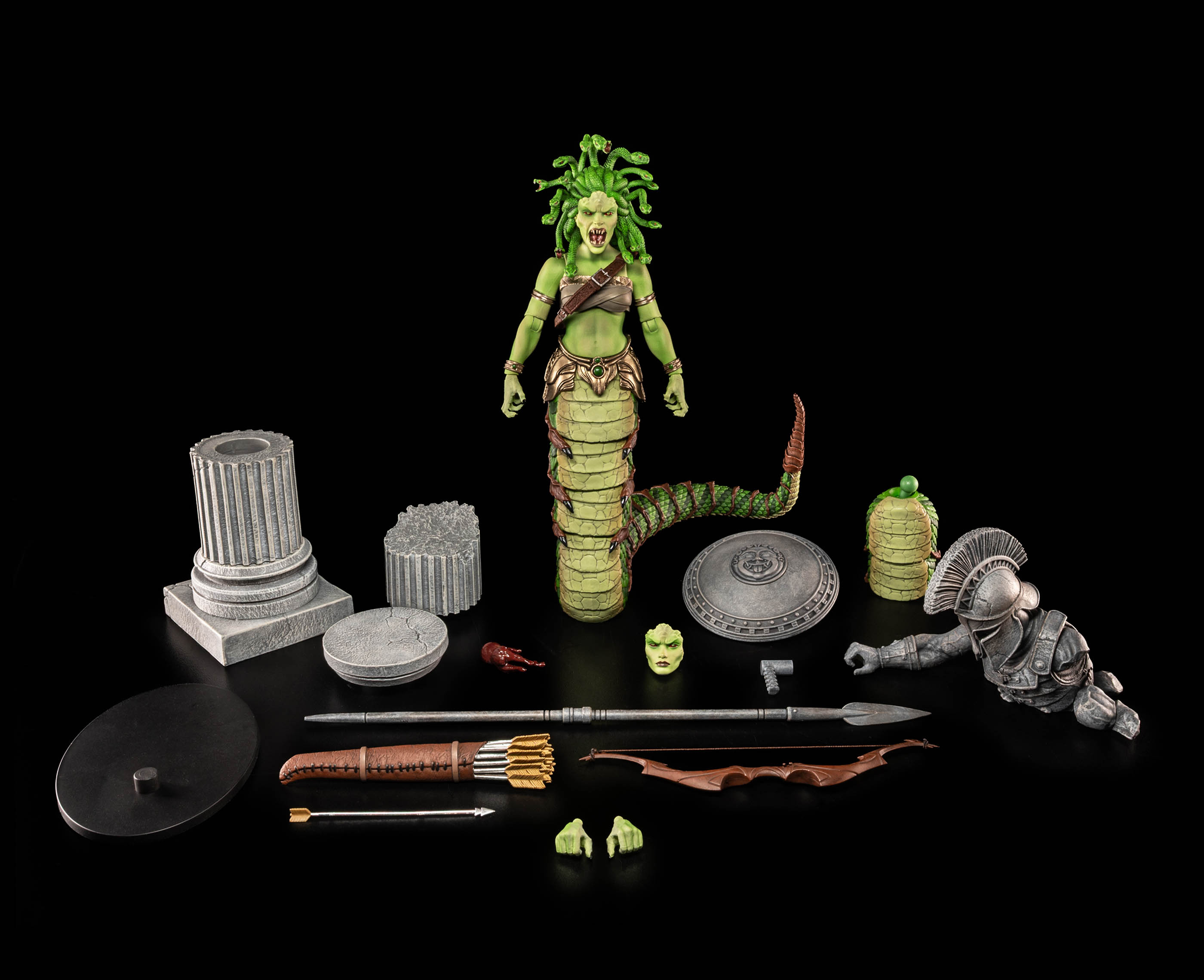
In the end, Eric decided to include 2 different portraits for Medusa – one which had a monstrous beauty to it, and another which showed the Gorgon enraged. Of course, he also had to include a piece that could be plugged under either head to recreate the “decapitated” look from the end of her tragic tale.
Diorama pieces have become a popular part of Figura Obscura releases over the years, and the Medusa release gave us the opportunity to once again add some diorama elements to display alongside this figure. Those elements include the “stone” remains of a warrior who foolishly challenged Medusa, along with his shield and spear (note – the head on that “statue” is indeed a 1.0-compatible head and helmet). Eric also decided to add some columns to the set, and he designed a modular system for those columns that allowed for different display options. Each column can be broken down into various pieces – the base, the middle, a broken section, and a top cap. You can even combine pieces from other columns (if you buy more than one Medusa) to build those columns up!
The Art of Medusa
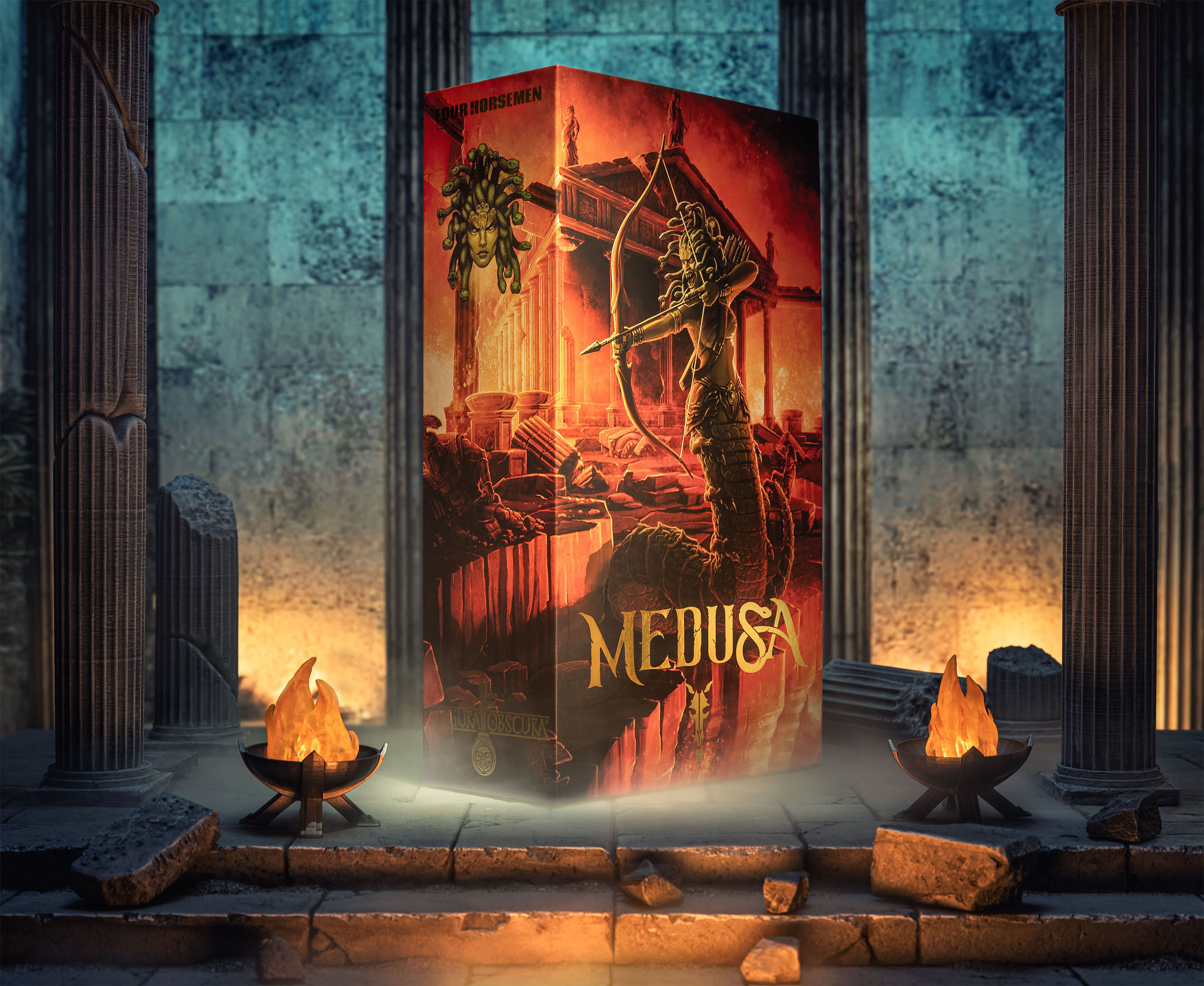
Like all Figura Obscura releases, Medusa comes in deluxe packaging featuring wonderful new artwork from Tom Tolman and Nate Baertsch. From the amazing illustration of Medusa on the front of the package, to the inner package illustrations and the portrait of the youngest of the gorgons – this packaging is another example of the next level of attention and love we give our Figura releases. You can see the package below.
The artwork created for this release was also used for a booklet that is included with each figure as well as mugs and pins that were sold alongside the figure and t-shirts offered by RetroRagsLimited.You can see the figure alongside the mug and pin below.
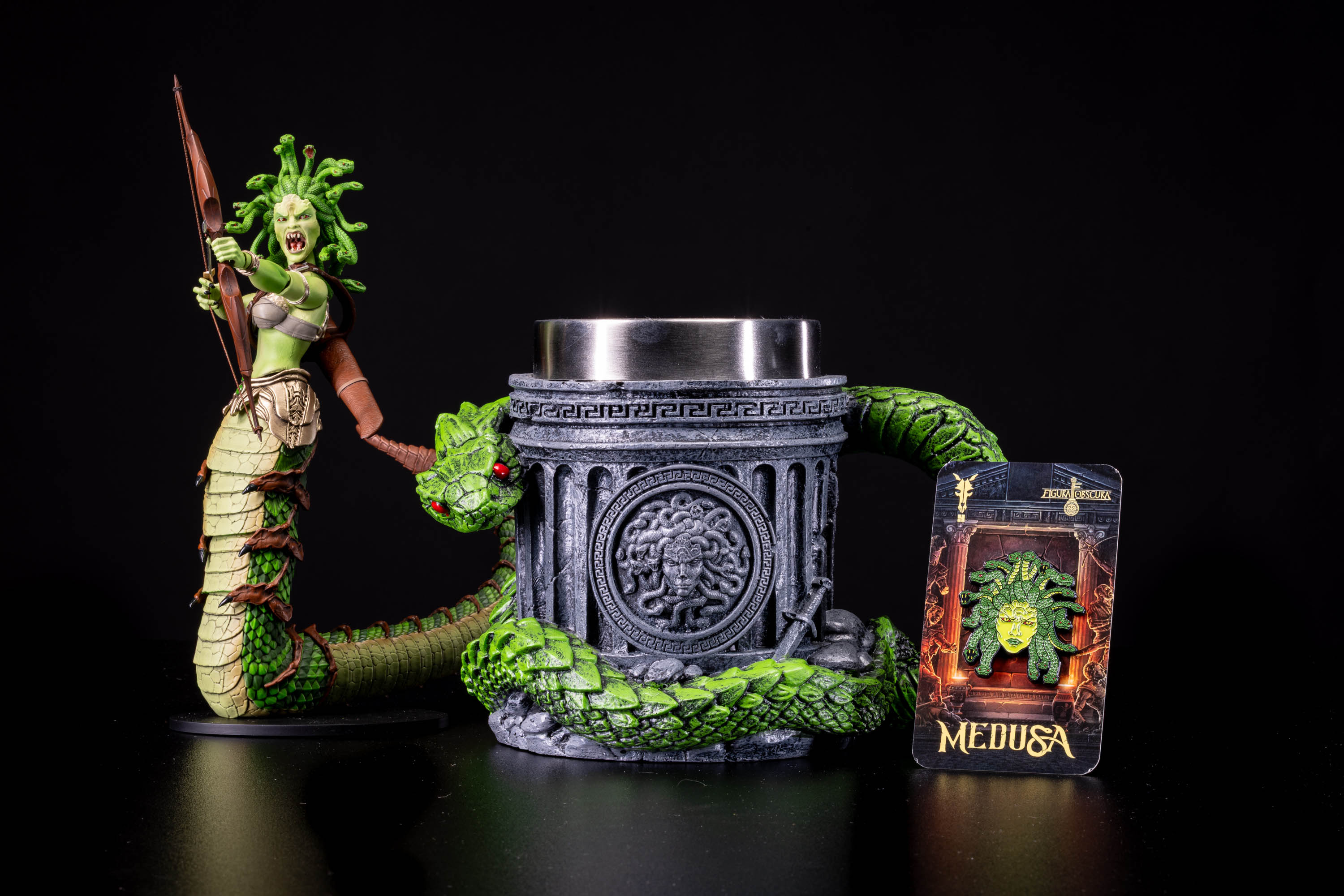
The mug for this figure's release is definitely something special! Wanting to go beyond just a simple branded mug, we decided to create a fully sculpted, custom piece depicting a stone column (and some of Medusa's victims) with a snake wrapped around to create the mug's handle!
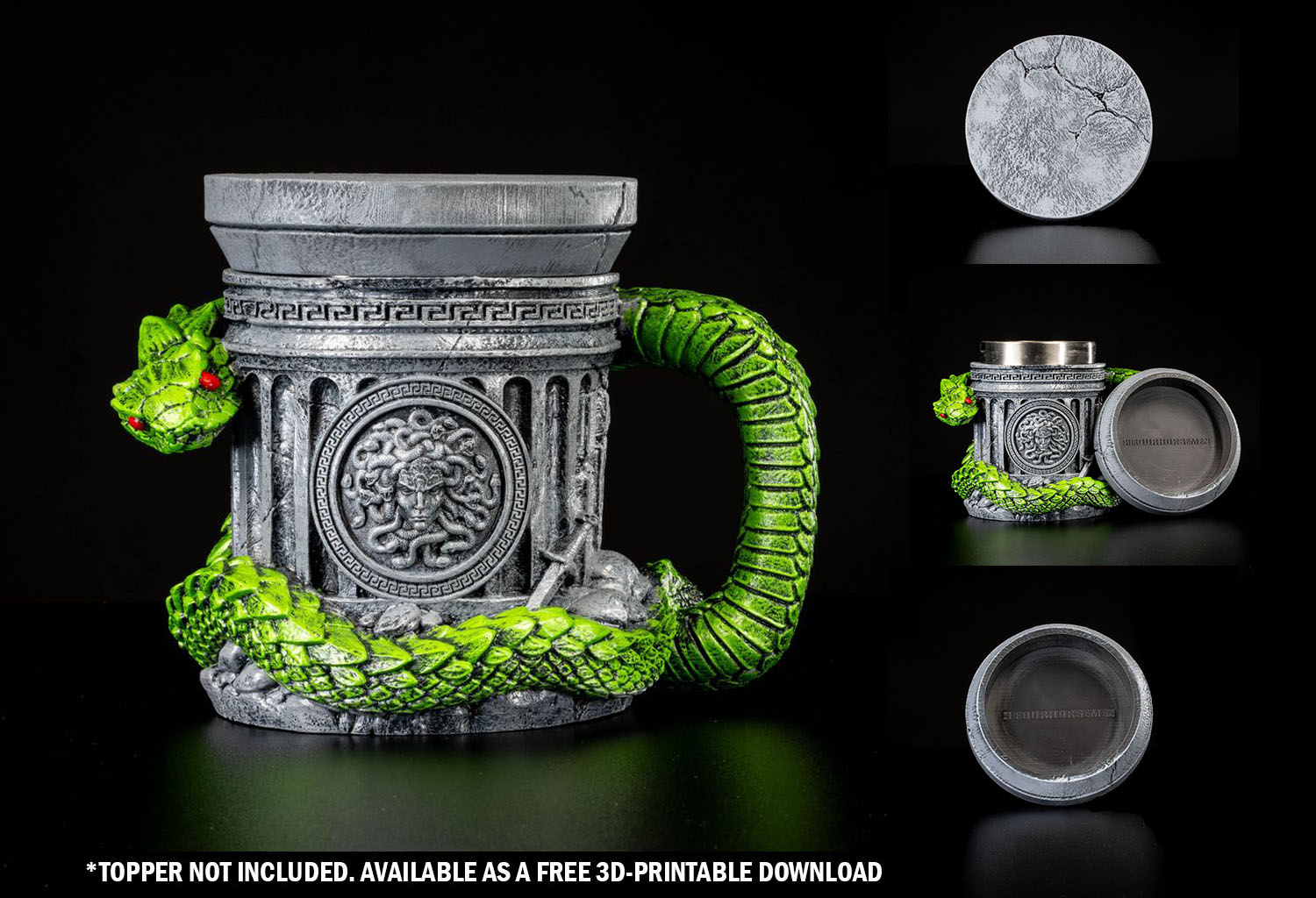
Once we had the mug in hand, we realized what an incredible display piece it made, and we decided to create a "topper" for the mug to turn the drinking vessel into a display stand. The topper was made using the same sculpture file as the column topper that comes with the figure's diorama-style pieces. It was modified to fit the top of the mug and we've decided to make it available to our fans as a free download that can be 3D-printed for use with the mug! You can see pictures of the mug with topper below and download the file to print here.
Don’t Look Now - Figura Obscura is Back
2026 has been an unusual year for Figura Obscura (remember back at Gcon 2025 when we told you to forget what you know about this line? We will surprise you!), but the release of Medusa has figure fans once again visiting its halls. Who will you look upon next in those halls? Only time will tell, but one thing is certain - this line is not going anywhere, and there are many more surprises roaming the halls of the Figura Obscura!